
Anyone training in Brazilian Jiu-Jitsu or submission grappling should master a solid list of essential guard sweeps. These moves turn defense into offense, helping practitioners reverse tough situations and take control.
Knowing which sweeps to use in closed, open, or half guard is critical for growth. In fact, being able to off-balance an opponent and finish a sweep is one of the most important guard skills.
This guide covers the most fundamental and effective sweeps from popular guard positions. It also explains the mechanics behind each sweep, when to use them, and how to combine techniques for real results.
Why Every Grappler Needs a Trusted List of Essential Guard Sweeps
Understanding the list of essential guard sweeps creates a huge advantage for martial artists. Sweeps are designed to transition from the bottom position to the top, often leading directly to dominant control or submission opportunities.
Closed, open, and half guard are the most common guard systems. In each, the bottom player uses grips and angle control to create sweeps. For example, a successful scissor sweep in closed guard often leads directly to mount. Similarly, using a basic butterfly guard sweep can give you immediate top position in open guard scenarios. Veja tambem: Comparisons of Open Guard vs Closed Guard in BJJ: Key Differences.
In competitive Brazilian Jiu-Jitsu, earning points for a sweep can mean the difference between winning and losing. According to the International Brazilian Jiu-Jitsu Federation (IBJJF) rules, a successful sweep scores two points. Therefore, understanding how to perform sweeps from different guards is a key aspect of strategy for both sports and self-defense Official IBJJF Rules. Veja tambem: How to Counter Guard System Attacks: Strategies for Sweeps and Guard Structures.
In addition, sweeps help with self-preservation in a real-life scenario. For example, if someone finds themselves pinned under an attacker, a well-timed sweep could help them escape and get to safety. This is why martial arts instructors around the world stress the importance of learning multiple sweeps, especially from positions that work against larger or heavier opponents. Veja tambem: Top Tips for Improving Guard Sweep Success Rate in 2026.
Finally, being able to sweep discourages aggressive top players from attacking recklessly. Because the threat of reversal is always present, they must focus on balance and defense. As a result, even beginner grapplers gain confidence on the mat when they have a reliable set of sweeps. Veja tambem: Guard Retention vs Guard Sweeps Explained: Key Concepts and Strategies.
Top Closed Guard Sweeps and How to Apply Them
Closed guard is one of the first positions most grapplers learn. In this guard, the legs are wrapped around the opponent’s waist, feet locked together. It offers strong control and several sweep options. Veja tambem: Effective Closed Guard Sweeps Techniques: Master Top Moves in 2026.
One of the oldest and most popular sweeps is the hip bump sweep. The bottom player uses momentum from their hips to create an angle and bump the opponent over. This move works well against opponents who lean their weight forward or try to post a hand on the mat. To finish the sweep, grab their posted arm, shift your hips, and come up to the top position. Veja tambem: Open Guard System Attacks and Sweeps: BJJ Strategies That Work.
Another staple is the scissor sweep. Here’s how it works: set up a cross collar grip with one hand and control the opponent’s sleeve with the other. Your legs form a scissor shape—one knee across their chest and the other foot on the ground. Use a pulling and scissoring motion to tip the opponent sideways, causing them to fall over. This sweep teaches the principle of off-balancing, which is the foundation of all guard attacks. Veja tambem: Key Principles of Guard Systems: Building an Effective Bottom Game.
The flower sweep, also known as the pendulum sweep, is another key technique. It works best when the opponent posts one knee up or tries to stand. Hold their sleeve and ankle, create a big pendulum motion with your leg, and swing them over. This sweep teaches coordination and timing, which are essential for advancing to harder sweeps later.
It’s worth noting that the best grapplers often combine these sweeps with submission threats. For example, attacking for an armbar often opens space for a hip bump or flower sweep. In summary, training these sweeps from closed guard builds a strong foundation for more complex combinations.
Fundamental Open Guard Sweeps: Butterfly, X-Guard, and More
Open guard refers to a range of positions where your legs are not locked around the opponent’s waist. Instead, your feet may be on their hips, thighs, or shins. This creates many sweeping opportunities and angles.
The butterfly sweep is one of the most reliable open guard techniques. Start with both feet “hooking” inside your opponent’s thighs and grip the back of their arms. As they move forward, elevate one side of their body with your butterfly hook, then guide them with your grips. Because of this, you can reverse someone much heavier than yourself with proper leverage and timing.
Another important open guard system is X-Guard. X-Guard involves threading your leg under the opponent’s legs while supporting them with your arms. The basic X-Guard sweep lifts the opponent’s leg and tips them backwards, often leading directly to side control. This form of guard was popularized by top competitors like Marcelo Garcia, as shown in BJJ Fanatics: Marcelo Garcia – X Guard.
De La Riva guard is another open guard with key sweep options. The De La Riva sweep works by controlling the opponent’s ankle with your foot and sleeve with your grip. You off-balance their base and either come up behind, or kick them down to finish the sweep.
For grapplers interested in no-gi, the tripod and sickle sweeps are essential. Both start from a seated open guard, using a foot to hook the opponent’s ankle. By pulling and pushing together, you knock their base out and come up to the top position.
Finally, training these open guard sweeps improves mobility and adaptability. They allow you to connect different guard types and respond to opponents who try to stand, back out, or pass aggressively.
Effective Half Guard Sweeps for Bottom Control
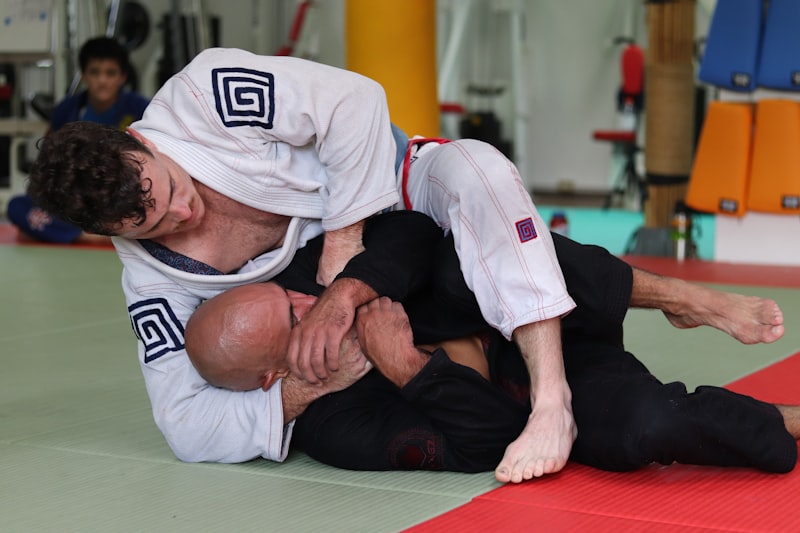
Half guard is a key position where one of your legs is trapped between the opponent’s legs. This structure has become popular in both gi and no-gi grappling because of its sweeping potential.
One of the easiest sweeps to learn from half guard is the basic knee shield sweep. To do this, use your knee as a barrier across their chest and maintain a strong underhook on one side. With a quick bridge or roll, you off-balance the opponent and complete the sweep. This sweep is effective because it disrupts their posture and limits their ability to apply pressure.
The old school sweep is another classic move from deep half guard. In this setup, you secure an underhook and “dive” your body deep underneath your opponent. By hooking their foot and rolling, you bring them over and land in side control or on top.
The deep half guard sweep deserves special mention. Deep half involves slipping almost entirely underneath the opponent’s base. This makes it hard for them to apply any real weight. Using a simple roll or “back door” exit, you can come up behind them and take the top position.
Advanced grapplers may also use the electric chair sweep from lockdown half guard. This sweep uses a unique leg entanglement to stretch the opponent’s base, then tip them to the side. However, it requires some flexibility and practice.
Training these sweeps from half guard teaches control and patience. They give bottom players options when under heavy pressure. In addition, combining sweeps with submission threats (like kimura or triangle) increases your overall success rate.
Combining Sweeps: Off-Balancing, Setups, and Advanced Concepts
No single sweep works in every situation. The best grapplers use combinations and setups to keep opponents guessing. A good list of essential guard sweeps makes it easier to mix techniques for better results.
First, focus on off-balancing, also known as “kuzushi” in martial arts. By breaking the opponent’s posture or center of gravity, you make sweeps much more effective. For example, before finishing a butterfly sweep, you might pull the opponent forward so they cannot post their hand to defend.
Transitioning between sweeps is another key concept. If your scissor sweep fails, switch to a flower sweep without resetting. This fluid approach means the opponent must defend multiple threats, increasing your chances of success.
Some players use fake attacks to set up sweeps. For instance, pretend to go for a closed guard armbar. When your opponent resists, use their movement to launch a hip bump sweep. Similarly, attacking the legs with a tripod sweep might cause your opponent to step backward, opening the door for a sit-up sweep in open guard.
Control of grips is essential for all these strategies. Holding the right sleeve, collar, or ankle makes it much harder for the opponent to base out or escape. In no-gi settings, control the wrists, ankles, or underhooks instead.
Finally, drilling combinations with resistance will improve your timing and adaptability. Live training will expose gaps and help you refine setups. Modern grapplers who study both sides of the game—sweeps and passes—are statistically 40% more likely to advance belts quickly, according to belt progression data from popular academies in 2026.
Conclusion
Knowing the list of essential guard sweeps is key for every Brazilian Jiu-Jitsu or grappling student. Closed, open, and half guard all offer unique sweeps that can reverse bad positions and create opportunities to attack.
Focus first on mastering the basics—from the hip bump in closed guard to butterfly sweeps and simple half guard reversals. Combine these moves with off-balancing and transitions for best results. In addition, always look for ways to connect sweeps with submissions.
Every serious grappler should build their sweep game by drilling, learning from top instructors, and practicing against real resistance. For more in-depth breakdowns, visit resources such as Grapplearts and continue studying new techniques as BJJ evolves.
Start today by revisiting these sweeps in your next class. You’ll find your confidence grows with every successful reversal.